

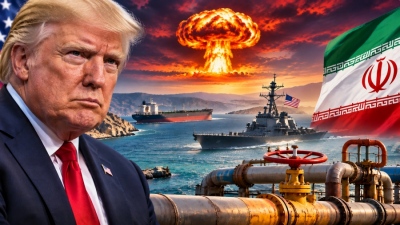
The next 72 hours could prove decisive for the course of the war in the Middle East. Diplomacy attempts to keep open the window for a deal between the US and Iran, yet talks in Doha concluded without a definitive outcome, while the military option remains on Washington's table. Donald Trump raises the rhetoric just hours before US polls open for the midterm elections, warning that Iran must accept a deal or face destruction. At the same time, Tehran insists on its terms, harbors no intention of reopening the Strait of Hormuz, and maintains its military readiness. The stakes now transcend the boundaries of a diplomatic confrontation. A new military escalation could send powerful shockwaves through the energy market, commercial shipping lanes, and the global economy as a whole, driving Middle East war escalation.
Doha brought no deal — Iranian delegation departed after three days
Intense negotiations between Iran and Qatari mediators took place during a period featuring signs of shifting tone from both Tehran and Washington. However, the Iranian delegation departed Qatar following three days of talks, according to Reuters. The departure, nonetheless, was not attributed to disagreements or problems arising during negotiations. On the contrary, according to an official cited by Reuters, a draft proposal between the two sides is already in the process of being exchanged to gather feedback and observations. Indeed, a new meeting is not ruled out. The critical question centers on whether upcoming hours will yield substantive progress or if the diplomatic process will exhaust its margins, influencing Doha diplomatic talks.
Iran's seven terms and Tehran's ultimatum on Hormuz
Mohsen Rezaei, Secretary of Iran's Supreme National Security Council, revealed that Tehran presented seven core terms via mediators following a request from the American side. If secondary conditions are factored in, the total number reaches eleven. According to Rezaei, initial US responses fell significantly short of Iran's demands. Subsequent proposals formulated through Qatari and Pakistani mediation reflected improvements but failed to resolve core pending issues. Tehran now awaits Washington's final response. The most critical point concerns the Strait of Hormuz. Rezaei clarified that reopening them will not be placed on the agenda until Iran's terms are satisfied. In this manner, Tehran retains one of its most important bargaining chips, while regional energy and commercial security remain exposed to the outcome of talks, reshaping Strait of Hormuz blockade.
Trump: "Deal or destruction" — Political pressure in Washington
Donald Trump appears to pursue a deal without abandoning threats of fresh military action. "Iran must either accept a deal or face destruction," he characteristically stated. Concurrently, he maintained he is attempting to find an interlocutor in Tehran, stating: "I am trying to find someone in Tehran with whom I could negotiate, but no one wants to assume leadership." The US President's telephone conversation with Benjamin Netanyahu heightened uncertainty surrounding Washington's upcoming moves. According to reports, options for a new strike against Iran are being examined in the US. American officials, however, have stated no final decision has been taken to execute a new military operation. Political pressure on Trump intensifies ahead of US electoral developments, as a prolonged conflict with mounting economic costs generates yet another difficult front for the US administration. The electoral dimension constitutes a critical factor in political calculations, though available data does not indicate it has dictated decisions regarding the war, altering US presidential war policy.
JD Vance's letter — Diplomatic way out or renewed pressure attempt?
Special significance attaches to the letter sent by US Vice President JD Vance to Mohsen Rezaei. According to reports, the correspondence is assessed as an effort to establish a channel of communication with a figure possessing significant influence within Iran's political system. Certain analysts view this initiative as an opportunity to avert the resumption of war, while others harbor reservations regarding Washington's true intentions. Iran's nuclear program and the extent of concessions Tehran is willing to make continue to constitute primary hurdles. Abbas Araghchi stated that proposals regarding the nuclear issue are being examined within the framework of the next negotiation phase. However, Iran has not yet announced a decision regarding participation in direct talks with the US, affecting US-Iran backchannel diplomacy.
Tucker Carlson: Nuclear strike against Iran within coming days
Meanwhile, American journalist Tucker Carlson maintains that the Trump administration may be close to deciding on using nuclear weapons against Iran, pressured by Israeli Prime Minister Benjamin Netanyahu. He cites intelligence regarding uranium enrichment facilities at Pickax Mountain, warns of potential global escalation, and reports that Donald Trump is weighing his options. Tucker Carlson issued a particularly severe warning, arguing that Donald Trump's administration may be mere days away from launching a nuclear strike against Iran under intense pressure from Israeli Prime Minister Benjamin Netanyahu. In a post, Carlson maintains that a potential target will be Pickax Mountain in central Iran, where, according to Israeli intelligence claims, the Iranian government has restarted its uranium enrichment program. He argues that no conventional weapon in the US arsenal can penetrate the roughly 300 feet of solid granite protecting the underground tunnels where enrichment reportedly occurs. By his assessment, the sole military option for destroying the facilities would be using a nuclear weapon. Carlson claims Netanyahu is pressing hard in this direction, noting characteristically that, per a person possessing knowledge of discussions, "Bibi calls Trump daily on the issue," defining bunker busting nuclear options.
Nuclear chaos or new deal — The true cost of a return to war
Eight months of conflict have failed to resolve fundamental differences between Tehran and Washington. A new military operation could trigger consequences far beyond the battlefield: heightened insecurity in the Middle East, rising energy costs, and disruptions to trade routes and oil and gas transportation. The prospect of nuclear escalation represents the most extreme scenario of such a conflict. However, specific material provides no confirmation that a decision to use nuclear weapons has been taken. Iran, for its part, declares it maintains military readiness and does not rule out negotiation failure, impacting global energy shock risks.
China and Russia in the diplomatic frame
Other major powers, such as China and Russia, could play a significant role in an eventual agreement. Their participation could offer multilateral support in monitoring commitment implementation and managing potential disputes between the two sides. The core objective is not merely a temporary ceasefire, but an agreement featuring concrete implementation mechanisms and guarantees that prevent a return to hostilities, driving multilateral peace guarantees.
www.bankingnews.gr







Σχόλια αναγνωστών